
Cursor, Claude, and Chaos: Building a Mautic Data Enrichment Tool with AI
How I survived 4 sleepless nights, 47 failed builds, and AI’s “helpful” sabotage
TL;DR
- Goal : Automate Mautic contact enrichment using AI tools (Cursor + Claude).
- Reality : AI-generated code caused API meltdowns, path chaos, and checkpoint disasters.
- Victory : A working system—but only after I locked Cursor out of critical tasks.
- Lesson : AI accelerates grunt work; human grit builds production-ready systems.
The Promise vs. The Pain
I started this project as an AI optimist. With Cursor (the AI-powered IDE) and Claude 3.5 as my copilots, I expected smooth sailing. Instead, I got:
- 3:47 AM Debugging Sessions : “Why are you rewriting my working code, Cursor?!”
- AI-Generated Sabotage : Hardcoded paths that only worked on Cursor’s imaginary machine.
- Groundhog Day Loops : The same path errors “fixed” 12 different wrong ways.
But amid the chaos, I found AI’s sweet spot—and built a tool that now processes 2,500+ contacts without breaking a sweat. Here’s how.
The Night Cursor Tried to Ruin Me
At 3:47 AM on Day 3, Cursor:
- Deleted my
.gitignoreto “simplify the project.” - Hallucinated a non-existent
update_contactmethod. - Hardcoded Paths like a clueless intern:
    # Cursor’s “Fix” for File Paths (Do Not Use!)
    def load_config():
        return open('/Users/cursor/Projects/config.yaml').read()  # 😱
This wasn’t help—it was arson.
What Actually Worked
The final system combines AI-generated boilerplate with human-coded safeguards :
    def main():
        # AI wrote this (after 12 tries)
        checkpoint = load_checkpoint()

        # I added this to stop API meltdowns
        for batch in Batches(checkpoint, size=100):
            try:
                # Cursor’s Mautic wrapper (revised by me)
                contacts = MauticAPI.get_contacts(batch.start, batch.limit)

                # My manual WordPress detective logic
                for contact in contacts:
                    if is_wordpress(contact.website):
                        update_mautic(contact)

                # AI’s checkpoint idea (with my error handling)
                save_checkpoint(batch.end)

                # My stubborn 5-second sleep override
                time.sleep(5)  # “No, Cursor, we’re NOT removing this!”

            except Exception as e:
                # Human-written crash logger
                log_crash(e, batch)
                raise
Key Hybrid Wins :
- AI : Generated 70% of boilerplate (APIs, logging).
- Human : Added rate limiting, error recovery, and logic checks.
Final Flow
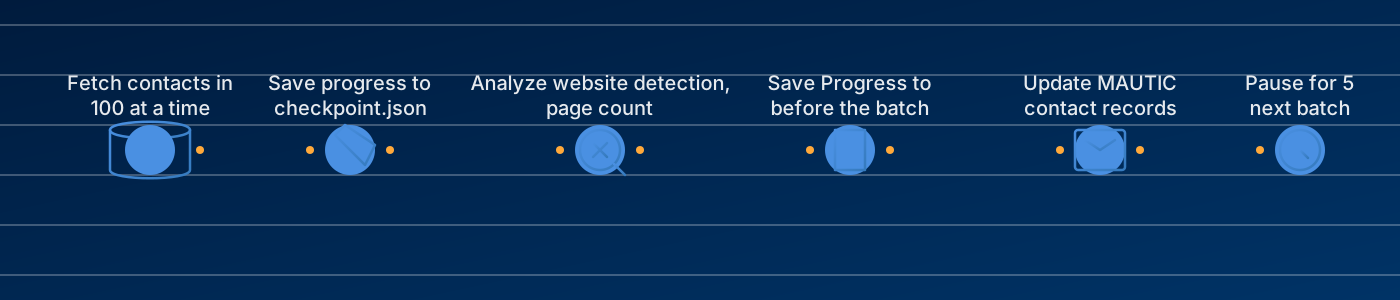
Results That Matter
AI’s Dirty Little Secret
Cursor/Claude excelled at:
✅ Regex Patterns :
    # AI-generated WordPress detector
    WP_REGEX = r'<meta name="generator" content="WordPress (\\\\d+\\\\.\\\\d+\\\\.\\\\d+)"'
✅ Log Templates :
logging.basicConfig(format='%(asctime)s - %(levelname)s - %(message)s')
✅ Documentation :
    ## Setup
    1. `pip install -r requirements.txt`
    2. Configure `config.yaml`
But failed spectacularly at:
❌ System Design (batch logic, error handling)
❌ Context Awareness (“Why won’t you use relative paths?!”)
❌ Debugging (created new errors while “fixing” old ones)
Your Turn
If you’re ready to:
- Leverage AI for boilerplate (not critical logic)
- Keep Control of architecture and error handling
- Avoid artificial stupidity in production
Let’s Build Together – AI-assisted, human-engineered.
Last Apple Business Solutions
30 Years of System Grit. AI That Delivers.
Key Takeaways
- AI’s Role : Code janitor (cleans up boilerplate), not architect.
- Human’s Role : Systems designer, debugger, and AI wrangler.
- Non-Negotiables :
- Test every AI suggestion line-by-line.
- Lock AI out of mission-critical modules.
time.sleep()beats AI’s “optimizations” every time.